






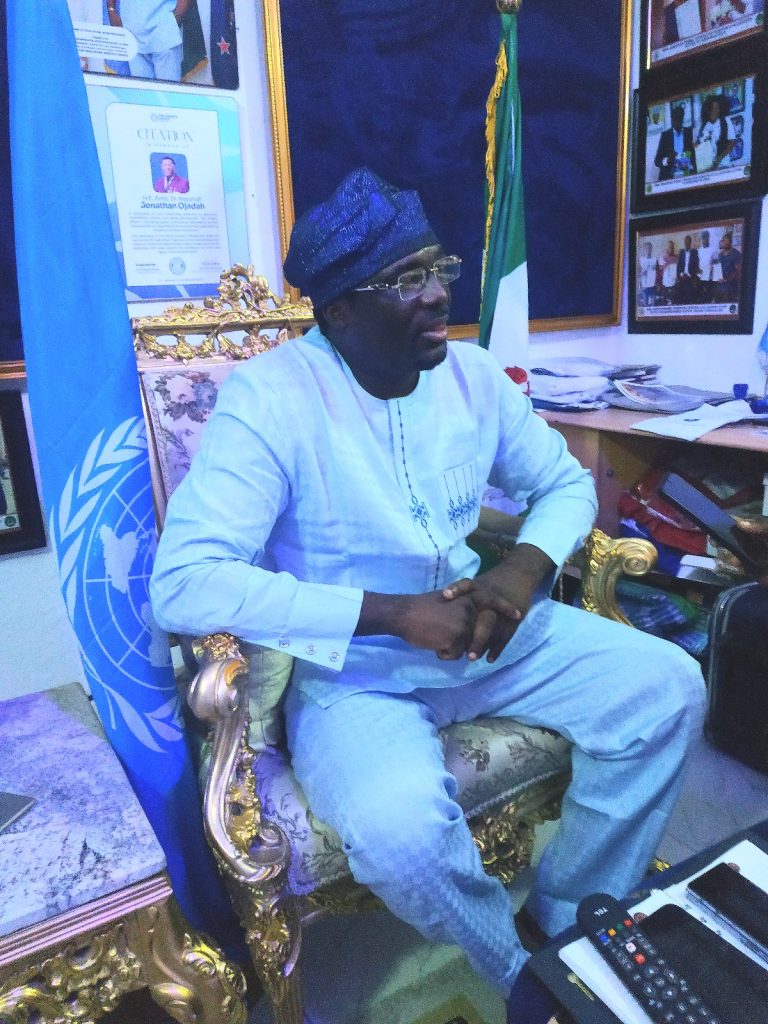
▪︎ UNIPGC Global President, Amb. Jonathan Ojadah
The Global President of the United International Peace and Governance Council (UNIPGC) and Permanent Representative to the United Nations Headquarters in New York, Ambassador Dr. Marshall Jonathan Ojadah, has called for greater national unity and stronger government action to address insecurity, stimulate economic growth, and strengthen good governance in Nigeria.
In this interview Ambassador Ojadah breaks it down, saying it is a litmus test that must suceed for democracy to survive. Enjoy:
What would you say is the major problem facing Nigeria’s security agencies?
For me, I would say the security system has been influenced by bad eggs within our military system. Flushing out those bad eggs could be a little bit dicey because, of course, we all know that when there is a bad egg, when there is a mole in the system, it affects communication and operational systems. So, it has really eaten deep into our security system, most especially in combating banditry and insurgency.
So that’s just my view on the issue and the state of insecurity in Nigeria because I believe that Nigeria has what it takes to flush out banditry and curb insurgency.
I know that the administration is really doing everything within its capacity to ensure that the military is well equipped. But because of the moles and the bad eggs within the system, it is hurting the system. It is truncating the system. It is reducing the efficiency and effectiveness of the workforce in combating this insurgency.
For some time now, citizens have not been too comfortable with the reform policies of His Excellency, President Bola Ahmed Tinubu, whose policies appear to be long-term. What short-term measures would you recommend to mitigate the effects of these reform plans?
As an economic diplomat, I believe that a collective workforce really needs to be adopted. By collective workforce, I mean that we need to look at the various sectors in different capacities—small, medium, and large-scale entrepreneurs. We need to focus on entrepreneurship because, with what is going on in the country now, I have realized that we cannot leave everything for the government to handle.
So, we have to adopt a system where both the citizens and the government work together, especially by encouraging production and manufacturing. As you can see, a lot of manufacturers and investors in large-scale industries are leaving due to bad governance and deficiencies in government.
If indigenous citizens collectively join forces and adopt a system of revitalizing our entrepreneurial sector, I believe it will encourage industrialization. Once industrialization is well established, it will increase our GDP.
I would not want to point fingers at the government because, as we all know, the economy is a shared responsibility.
Mr. President is trying, in his own capacity, to bring together technocrats. But just as I said earlier, the same challenge we are having with our security apparatus and security architecture is also affecting the system of government.
There are some leaders in government who are truncating efficiency and effective administration. They are hindering the process of achieving good governance.
So, what more would Mr. President do? He has made several changes by replacing people who were not performing, with the hope that the new appointees would perform better. You can see how he changed the CBN Governor to another CBN Governor just to ensure economic and national development, increase GDP, and stabilize the economy.
But you can still see that the problems continue to reoccur. This tells us that we cannot leave these problems to the government alone. It has to be a joint effort between the citizens and the government.
United Nations, I know, have benchmarks, and I believe Nigeria ranks low on the Human Capital Index when compared with some countries in Africa. You mentioned capacity earlier, what can we do to increase our Human Capital Index? Talking about capacity, what can we do as a nation? Should we increase budgetary allocations to human capital development?
I believe that, for all of those benchmarks to improve, we also need to develop our people. If we build infrastructure but fail to build people, they may eventually turn around and destroy what we have built.
So, following what you have said, without a properly structured human capital development system, whatever economic progress we strive for will amount to little or nothing because we need the workforce. We need human capital development.
So, it is not just about increasing the budget. Most times, when these budgets are increased, the funds or allocations are wrongly disbursed, and at the end of the day, they end up in the pockets of leaders instead of reaching the appropriate channels for proper use.
Therefore, I would rather encourage the government to focus on developing youths and women under the umbrella of human capital development. We should encourage them to engage in small-scale enterprises.
If the government can develop a system through which these youths can be properly empowered with a sophisticated M&E (Monitoring and Evaluation) programme, then after being empowered, I am very sure we would accelerate the economic development of the country.
Most youths possess technical know-how and have acquired valuable skills. However, many of them lack the financial capacity to transform those skills into productive ventures.
The knowledge they have acquired remains unused because they lack the resources to put it into practice.
If they are provided with proper financial support, which boosts their productivity, alongside a strong Monitoring and Evaluation (M&E) programme, I am confident that we would witness significant growth in manufacturing, mining, innovation, and many other sectors.
I am very sure that Nigerian youths have a lot to offer.
Recently, Ambassadors were designated to various countries. One of the challenges we’ve noticed is that some of them are yet to present their Letters of Credence. We still hear terms like “Ambassador-Designate” because some have not been formally accepted by their host countries.
What do you think is responsible for this? Do you think Nigeria needs to do more public relations to improve its image internationally? What are some of the challenges Diplomats face representing Nigeria? What is the general perception of Nigeria on the international stage?
The truth is that Nigeria needs what I call image rebranding. This rebranding must be a collective responsibility of every Nigerian, especially those representing our great nation abroad.
Nigeria is a great country. We are respected across the world because of our human capital, our natural resources, and the resilience of our people.
Regarding ambassadors, there are many challenges they face outside the country. Before an ambassador can present a Letter of Credence to the Head of State of a host country, certain diplomatic agreements and protocols must first be concluded. Those arrangements must be properly finalized before the presentation can take place.
Where those requirements have not been fully met—where the “i’s” have not been dotted and the “t’s” have not been crossed—the ambassador remains an Ambassador-Designate until all diplomatic processes are completed.
I also want to use this opportunity to appeal to the Federal Ministry of Foreign Affairs to improve its operations. Many ambassadors encounter serious challenges that are directly linked to delays in communication from the Ministry.
Through diplomatic channels, ambassadors often send important requests that remain unanswered for weeks or even months. There are also communication gaps between government agencies and the Ministry of Foreign Affairs.
For instance, when a government minister is scheduled to visit another country on official duty, diplomatic protocols require formal communication between both governments. If the necessary approvals or confirmations are delayed from the home country, that minister may be unable to carry out official engagements in the host country.
I have personally witnessed situations where ministers were left waiting because official diplomatic clearance from Nigeria had not been completed. Such delays affect Nigeria’s image and undermine diplomatic effectiveness.
Therefore, I strongly encourage the Ministry of Foreign Affairs to become more proactive. There should be effective communication with Ambassadors, High Commissioners, and diplomatic missions across the world.
Infrastructure is another major concern. When you visit some Nigerian embassies abroad, you sometimes wonder whether they truly represent Nigeria. In many cases, government funds have reportedly been approved for renovations, technological upgrades, or infrastructural improvements, but those projects are either delayed or poorly executed.
When resources are not properly managed, the burden falls on the ambassadors, whose performance is then unfairly judged despite circumstances beyond their control.
Many ambassadors are facing enormous challenges. However, because diplomacy requires restraint, they cannot openly express these concerns. Like members of the military, they often endure difficulties while remaining professional.
Those of us who are non-career diplomats can speak about these realities and respectfully call on the government to establish effective mechanisms and committees to address these issues.
Although you live in Nigeria, you spend a significant time outside the country. How do you manage different time zones while coordinating your businesses both in Nigeria and internationally?
Diplomacy is more than a profession to me—it is a passion.
My first major diplomatic assignment came in 2021 when I participated as an election observer during the elections in Lusaka, Zambia. That experience inspired me immensely and strengthened my commitment to promoting good governance, democracy, peace, and stability across Africa.
I witnessed an electoral process where citizens peacefully exercised their constitutional rights. They desired a change in leadership and achieved it through orderly democratic participation rather than violence or unrest.
As election observers, we were impressed by the discipline, cooperation, and patriotism displayed by the Zambian people. It made me wish that every African nation could embrace such democratic maturity.
These experiences have strengthened my passion for diplomacy. As I continue promoting sustainable peace across Africa and beyond, I have seen governments and leaders embrace the principles of good governance, conflict prevention, and peaceful coexistence. When you engage in projects that produce real results and positive change, your motivation naturally increases.
By the grace of God, I have participated in peacebuilding initiatives involving the Democratic Republic of Congo and Rwanda. These experiences exposed me to Alternative Dispute Resolution (ADR) mechanisms and various conflict-resolution strategies aimed at restoring peace and improving relations between both countries.
Although challenges still exist, I have witnessed firsthand the efforts of African leaders and international stakeholders working tirelessly to promote peace and stability. You also visit countries like Uganda, where one leader has remained in power for many years. Many people criticize such situations from a distance. However, as diplomats, we are trained to examine both sides of every issue.
While some criticize long-serving leaders, we also observe developmental projects and governance outcomes that help explain why sections of the population continue to support them.
Every situation has two sides. It is important to evaluate governance based on measurable results rather than assumptions alone.
Likewise, there are governments that spend enormous public resources but achieve very little. Those are equally deserving of criticism.
Therefore, diplomacy teaches us to assess every situation objectively, understand the local realities, and promote peaceful dialogue rather than emotional judgment.